Tampilkan postingan dengan label articles. Tampilkan semua postingan

Conquer Empty Nest Syndrome

Empty Nest Syndrome is a feeling of great loss or sadness when a child leaves home to go to college or just to get out on their own.

If you are the child’s mother or mother figure, you may experience a true sense of loss, loneliness or even worthlessness. You may feel your job is over (its not!) and you child doesn’t need you anymore. (They do!)

For some, not being involved in your child’s everyday life and this is not just for mothers, but father too, may create a temporary identity crisis. You may find yourself depressed or anxious experiencing unaccountable tears or simply being highly emotional. You may wonder who you are and what are you worth, if not as a parent.

Believe it or not, this can truly be a significant and positive transition and period of growth for you!

Here are 5 secrets to ensure a healthy new life for you, without that much work:

  1. Renew your marriage vows.
    If not literally then figuratively. It just might be time to remember why you are together and all the wonderful times you had before kids. Do a date night. Join a dance club or some activity that you both enjoy and can do as a couple. Now is the perfect time to re-create your partnership and enjoy the life you both deserve, together, without children. Ask your partner, set a plan together. How will you use this time together? Single? No problem! What can you do to enhance the relationships you do have, now that you have the time? Write it down. Now follow through.

  2. Relish the time alone.
    You now have that peace and quiet that you have been wanting. Remember when they played their music too loud, their friends were too noisy and you wondered if there would ever be peace again? Well, there is, right now! What are you going to do? Read? Knit? Paint? How will you use your quiet time? Make a list.

  3. Reignite or begin new friendships.
    Solitary pursuits are great, but you need people in your life also. Think about the friendships that might have gotten put on the back burner while you were raising your children. Contact them! Tell them you are much more available and wanting to renew the friendship you once had. You also might want to add new friends to the mix. Get yourself out there. Socialize. Sign up for classes. Learn a new language or learn more about computers. Classes are a great way to do something you love and meet new people at the same time. How are you going to branch out now? Make a list.

  4. Broaden your horizons.
    Make your world bigger. When was your last trip or vacation? You don’t have to go around the world, just get out of town. Expand your world view. Pick a place and go. Explore. Your children are making their world bigger just by leaving home. Now it’s your turn. Where are you going?

  5. Find something meaningful and of value.
    Raising your children has been a full time job. It’s certainly been meaningful for both of you. Now they are gone and you need to replace that, you need another way to do your special work. What are your strengths? What are your skills? How can you use these to help others? Whether it’s through church, community, or more global, your gifts are needed. What are your special gifts? How are you going to us them?

Life is a journey. Not only are your children embarking on one, but so are you. Take a look at the big picture of your life. Having your children go off to lead their own lives is just one small piece. Consider this time of your life a step forward, a step in the right direction. You now have your very own life, so go lead it! <<
Kim Kirmmse Toth is a strengths based coach who works with boomers on transition. These may include re-crafting or re-careering so the work is a joy and not a dread. Go to www.redhotretirement.com and sign up for her free Top Ten Retirement Secrets!


by Kim Kirmmse Toth
Read More >>

11 Relationship Traps of Depression

Depression sets relationship traps for both partners. Everything can change quickly between two people, and it’s crucial to be able to spot these changes as soon as possible.

Here are 11 signs of the illness that seem perfectly designed to undo the bonds of closeness.
Humor, talking and doing things together, sharing special moments – they’re all gone.
In their place are avoidance, anger, blame and isolation.
Read More >>

Next - Indonesia Is The Most Corrupt Country In The World (Public Skepticism)

Some people might think of this as a bad news, but considering where Indonesia had been on corruption scale worldwide this is certainly a good news for Indonesia as well as the Government.

Transparency International which is a global network including more than 90 locally established national chapters and chapters-in-formation, has released its 2010 CPI (Corruption Perception Index) which is a “degree to which corruption is perceived to exist among public officials and politicians”.

Since corruptions by nature are most of the time hidden, it is very hard to quantify the degree of corruption in a country. Transparency International overcome this by surveying businesses and individual in the targeted country. The 2010 CPI draws on different assessments and business opinion surveys carried out by independent and reputable institutions. It captures information about the administrative and political aspects of corruption.

Broadly speaking, the surveys and assessments used to compile the index include questions relating to bribery of public officials, kickbacks in public procurement, embezzlement of public funds, and questions that probe the strength and effectiveness of public sector anti-corruption efforts.

Indonesia has been steadily increase it standing from 1.9 in 2002 to 2.9 in 2010. While these increase are very small considering the CPI scale is 1 to 10, Indonesia is no longer the most corrupt country in the world, not even the most corrupt country amongst the Asean members.

Indonesia now ranks at no 110 out of 182 countries in terms of most corrupt countries in the world, sharing the ranks with Benin, Gabon, Bolivia and Solomon Island.

Other Asian countries that ranks below Indonesia includes Vietnam, The Philippines, Myanmar, Pakistan and Timor Leste.

Amongst the star on this year CPI compare to last year are Bhutan, Chile, Ecuador, FYR Macedonia, Gambia, Haiti, Jamaica, Kuwait and Qatar. While the following countries the Czech Republic, Greece, Hungary, Italy, Madagascar, Niger and the United States showed deterioration.

United States are again showing a decrease this year and now ranks at number 22. The so called “Beacon of Democracy” is now lagging behind countries such as Chile, Ireland, Qatar, Hong Kong and Singapore.

The top 10 cleanest country are
1. Denmark
2. New Zealand
3. Singapore
4. Finland
5. Sweden
6. Canada
7. Netherlands
8. Switzerland
9. Australia
10. Norway

While the tools employed by Transparency International to gauge corruption level in a country may not be perfect, at least for the time being Indonesian can feel good about themselves, especially with all the natural disasters that keeps coming as if we as a country are collectively being punished by the almighty.

Jakartauptodates.com
Read More >>

Indonesia Is The Most Corrupted Country In Asia Pacific

Indonesia is again falling down the corruption ladder amongst countries. A study released by Political and Economy Risk Consultancy (PERC), a consulting company based in Hongkong, to gauge corruption levels in investment destination countries in Asia Pacific region.
Read More >>

Indonesia's Economic Freedom in The 2012 Index - The 115th Ranking In The World

Indonesia’s economic freedom score is 56.4, making its economy the 115th freest in the 2012 Index. Its score is 0.4 point better than last year, with improvements in half of the 10 economic freedoms including monetary freedom and the control of government spending. Indonesia is ranked 23rd out of 41 countries in the Asia–Pacific region, and its overall score is below the world average.

Indonesia has undertaken wide-ranging reforms to address various structural weaknesses in the economy and to improve competitiveness. The economy has shown considerable resilience, weathering the global economic slowdown relatively well, and annual growth rates averaging over 5 percent have been achieved during the past five years. Recent reform measures have put greater emphasis on improving regulatory efficiency, enhancing regional competitiveness, and creating a more vibrant private sector through decentralization. Public finance has been well managed, and debt has been kept under control.

Despite the progress in economic restructuring, Indonesia’s growth potential remains fragile and hampered by inefficient legal and investment regimes that undermine entrepreneurship and job growth. Lingering political interference in the private economy discourages dynamic change, and pervasive corruption and a weak judicial system add uncertainty and risk, particularly to new economic endeavors.

Background


Indonesia is the world’s most populous Muslim-majority democracy. In the years since 1998, when long-standing authoritarian ruler General Suharto stepped down, Indonesia’s nearly 250 million people have enjoyed the blossoming of a wide range of political freedoms, and participation in the political process is high. President Susilo Bambang Yudhoyono has cracked down on corruption and has tried to encourage much-needed for­eign investment, but the weak rule of law remains a major impediment to attracting capital. As a member of the G-20, Indonesia is playing an increasingly important role in inter­national economic policy discussions.

Rule of Law


Property rights are generally respected, but enforcement is inefficient and uneven. The judicial system is not fully independent and remains vulnerable to political influence. In the absence of an efficient legal framework, court rulings can be arbitrary and inconsistent. Protection of intellectual property rights is not up to world standards, and the market for pirated goods has been expanding. Corruption continues to be pervasive.

Limited Government


The top income tax rate is 30 percent, and the top corporate tax rate is 25 percent. Other taxes include a value-added tax (VAT) and a property tax, with the overall tax burden amounting to 11.4 percent of total domestic income. Government spending is equivalent to 16.7 percent of GDP, and the budget deficit has come down to around 1 percent of GDP. Declining public debt has fallen below 30 percent of total domestic output.

Regulatory Efficiency


Despite notable simplification of licensing requirements, launching a business still takes more than the world average of seven days and 30 procedures. Overall regulatory efficiency is weak. Compared with other economies in the region, Indonesia’s rigid labor market imposes more regulatory costs on the creation and termination of employment relationships. Inflation has been modest, but government interference in the market still distorts prices.

Open Markets


The trade weighted tariff rate is 3.1 percent, but trade flows are constrained by costly non-tariff barriers. Although the country publicly welcomes foreign investment, many investors, foreign and domestic alike, face significant hurdles due to inconsistencies in the investment codes and erratic enforcement. The financial sector is dominated by commercial banks, four of which are state-owned. Capital markets are not fully developed.
www.heritage.org
© 2012 by The Heritage Foundation. All Rights Reserved.
Read More >>

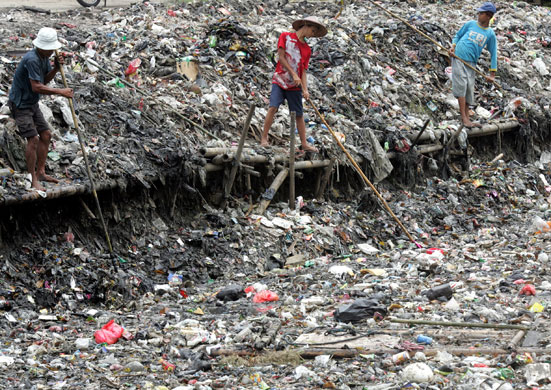
The Citarum of Indonesia Is The Dirtiest River in the World


What happens when nine million people throw their trash in a river, and corporations use it to dump hazardous waste? It becomes like the Citarum in West Java, Indonesia – choked with plastic, loaded with chemicals and human waste. A generation ago, the Citarum River was a peaceful waterway where wildlife enjoyed the clean, fresh water and villagers caught fish and made a living off the rice paddies.


The villagers can’t make money off of fishing anymore, so they’ve turned to picking through the trash that floats on the surface to find items that can be sold or traded. Rapid industrialization in the ‘80s is what led to this: more than 500 factories line the banks of the 200-mile river, many of them leaking textile treatment chemicals into the water. The trash that floats on top is the result of the lack of a trash pickup service in the area. All of the houses, factories, and other buildings along the river pour human waste into it for lack of anyplace else to put it.


Many people who live in the area still collect the water to drink, cook with and wash their clothes – they don’t have much choice, as it’s the only nearby source of water.


It’s unknown whether the Citarum really is the most polluted river in the world, since no study has ever been done to conclude such a thing. There are many other rivers that are also incredibly polluted, and many of them are located in Asia. Part of the problem is that wealthy countries like America pay poor Asian countries to take huge barges of our trash to dispose of. Electronics make up the bulk of it, and as today’s equipment becomes obsolete and we purchase tomorrow’s to replace it. Many of the world’s rivers may see fates similar to that of the Citarum River if we don’t begin a major overhaul of our sanitation systems, and help other countries with their waste management as much as we can.


 Stephanie Rogers
Read More >>

What is love, hate, and emotion?


Scientists have largely answered this question already, but as with most neuroscience, the details remain fuzzy. It is quite clear from decades of research that everything we feel, whether it be sensation or emotion, is mediated by the release of molecules, largely neuropeptides, between synapses in the brain.

Dopamine, serotonin, epinephrine, and a large cadre of other small molecules act as the signals between our brain cells. Our understanding is growing piecemeal, but as with the emergence of consciousness, soon we will hopefully be able to synthesize a complete model of emotion, including not only happiness, anger, sadness, joy, fear, and courage, but also spiritual experiences, amazement, and euphoria.

Daniel D. Brown.
lifeboat.com
Read More >>

Leadership in Organization


Effective managers are not necessarily true leaders. Many administrators, supervisors, and even top executives execute their responsibilities successfully without being great leaders. But these positions afford opportunity for leadership. The ability to lead effectively, then, will set the excellent managers apart from the average ones.

Where as management must deal with the ongoing, day-to-day complexities of organizations, true leadership includes effectively orchestrating important change. While managing requires planning and budgeting routines, leading includes setting the direction (creating a vision) for the firm Management requires structuring the organization, staffing it with capable people, and monitoring activities; leadership goes beyond these functions by inspiring people to attain the vision. Great leaders keep people focused on moving the organization toward its ideal future, motivating them to over come whatever obstacles lie in the way.

Organizations succeed or fail not only because of how well they are led but also because of how well followers follow. Just as managers are not necessarily good leaders, people are not always good followers. The most effective followers are capable of independent thinking and at the same time are actively committed to organizational goals. As a manager, you will be asked to play the roles of both leader and follower. As you lead the people who report to you, you will report to your boss. You will be a member of some teams and committees, and you may chair others. Effective followers are

distinguished from ineffective ones by their enthusiasm and commitment to the organization and to a person or purpose other than themselves or their own interests. They master skills that are useful to their organizations, and they hold to performance standards that are higher than required. To be a good leader you must become a good follower first.

The article was written by Patricia Coleman, a full-time employee of MillenniumEssays.com. Patricia specializes at custom written essays, and supervises projects in research paper.

By Patricia Coleman
Article Source: EzineArticles
Read More >>

START BELIEVING AND CONTINUE BELIEVING


Believe is one of the main agenda in becoming successful. If you ask all successful person such as CEO of multibillion company, Directors, Billionaire and even Millionaire, they always says that they start with a dream and then they believe in their dream and make it to happen by never stop believing.

Now a day, personal development has becoming one of the needs in our life. More and more people are looking to be successful. It  does not matter in which field you are in. Success cannot be reach overnight, it needs to be developed and believe in  reaching it. To believe in what we do is something we need to have in our mind every minute and everyday. This is something that most successful people have in their mind and heart. People who failed is the people who stop believing in what he/she can get or forgotten their dream.

How you want to stay remembers and believes in your dreams? 


There always a lot of ways to stay in the correct direction or stay motivated towards achieving your dreams. Support from family or friends are one of the ways to stay motivated.


“Now more than ever, people are turning to gurus for help in a variety of areas,” Marketdata’s Research Director John LaRosa says about the self-improvement market. “They want to be in control in their emotional and financial lives”.
Today most people now have been spending their money to stay motivated attending motivation class or course. Also reading books written by the successful person him/herself that has been release to guide and make you believe in your dreams. Reported that the highest ranking book always be a motivation book. An estimate $693 million worth of self-improvement books were sold in 2005. Robert Kiyosaki’s Rich Dad, Poor Dad has been on the New York Times Best Seller list for several years straight and has sold more than 20 million copies.


Now online i.e. in the internet, program of self-improvement and development has been increasingly popular as self-helped. By doing at home or anywhere else at any time the course can be attended.


Beside a personal interest in self-improvements, multibillion companies now are sending their staff to such program to compete in the business. They know that they need a highly self-esteem and highly motivated staff to achieve their sales and profit target. Each year they sending their managers or senior staffs who work for their company plan. So their manager and senior staff always believe in achieving their profit.


Therefore always believe in your dreams and work for it and make sure to always continue believing that you are becoming successful.


source: http://www.goarticles.com


Read More >>

Positive Thinking Doesn't Work Alone

“Discontent is the first step in the progress of a man or a nation” ~ Oscar Wilde
Fact
Depressed people swear by this: That as many positive thinking as they conjure in their heads, it doesn't lift the gloom. As many happy thoughts, achievements and positive self-images they reflect, nothing in the imaginary world has the power to pick up the awful drops of mood.


Cause
Positive thinking doesn't work because it's only smoke and empty calories. Just thinking it doesn't bring results or create change. Yes, it may help a little with beginnings and endings, but it doesn't feed the hungry, or fix a car or make the sun raise a little sooner.

Intervention
If a positive idea makes you more depressed, then it's no longer a positive thing, is it?
The big positive ideas may shy to admit their dirty little secret: That positive thinking only works if it's followed with continuous, tedious, positive sweating. Whether in series of steps or trials and errors, positive thinking need to be worked out, to be tested and proven to remain positive.
In short? Positive thinking is worthless without positive action. 

Positive Minds
Since we can't change the world in bulk, doesn't it mean that positivity is limited to the work that we can manage? And the changes that we can handle? And the results that we can create? What, a made up room? A decent lunch? A scrubbed toilet? Hell, yeah.
Is that why the most positive people are the ones with lesser ideas in their heads, and more sweat on their brows?


source  hning
Read More >>